Market Research at the Speed of Business
Business decisions don't wait for research timelines. Alchemic delivers qualitative depth at the survey speed. Answer leadership's “why” before the next board meeting.
[The Problem]
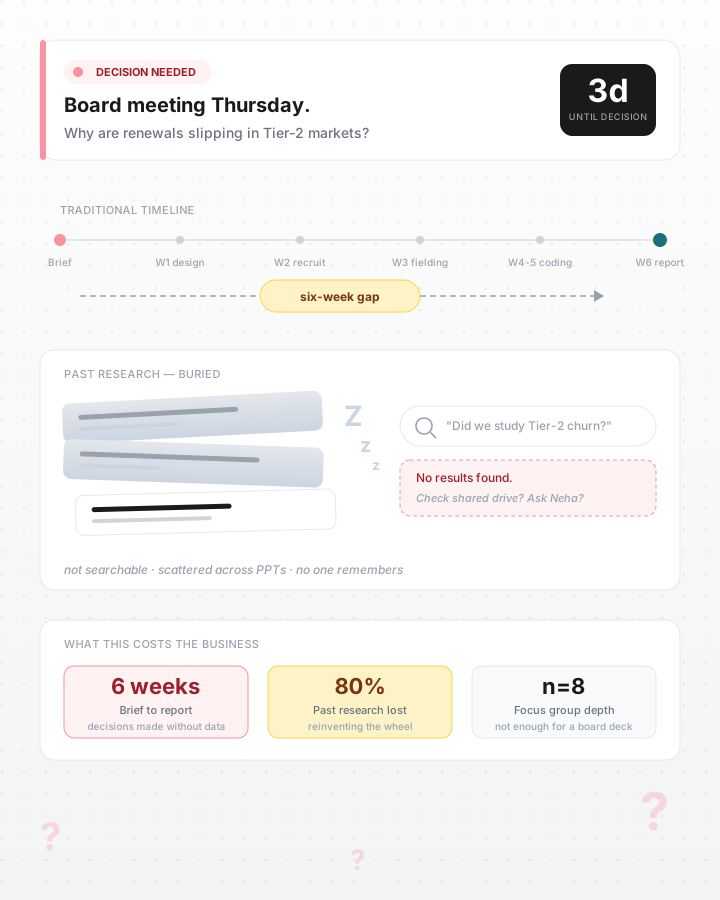
Traditional Research Can't Keep Pace
Strategy decisions need consumer insights. Traditional research takes weeks. You're choosing between shallow survey data that executives question, or deep research that arrives too late. Critical questions go unanswered:
- How do we justify six-week timelines for insights needed today?
- Where did we already explore this in past research?
- How do we turn findings into actionable recommendations?
[The Solution]
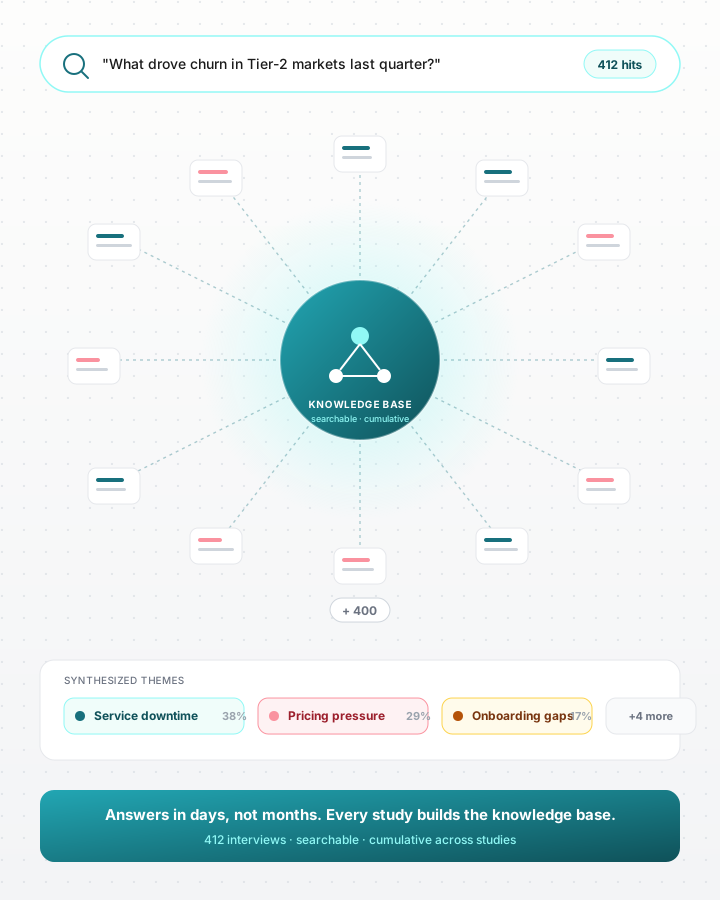
Qualitative Depth at Scale
Alchemic delivers consultancy-grade research at survey speed. AI-moderated interviews with hundreds of consumers simultaneously. Nuanced insights in days, not months.
Dynamic Knowledge Base
Every interview becomes searchable intelligence. Query past research. Connect insights across studies.
24/7 Global Research Team
Hundreds of concurrent interviews. 57+ languages. Statistical confidence with qualitative depth.
Instant Actionable Insights
AI generates consultancy-grade reports with key themes, summaries, and consumer verbatim quotes.
[How It Works]
Market Research in 3 Simple Steps
Define Your Research Objective
Share your hypothesis or knowledge gap. Our expert human researchers tailor the AI to your specific study.
AI Conducts the Interviews
AI moderator conducts personalized interviews with target customers. Adapts based on responses, probes themes, and builds understanding across hundreds of consumers.
Get Actionable Insights
AI analyzes conversations with human oversight. Instantly delivers actionable and presentation-ready insights you can use immediately.
Trusted by brand and insights teams at






“Alchemic is ridiculously fast, and getting both qual and quant insights at that speed is a game-changer.”
[Testimonials]
Discover what our clients have to say about our consumer research services
Frequently asked
About this product
What is market research and why does it matter for product decisions?
Market research is the process of gathering and analysing data about a market, its customers, and the competitive landscape to inform business decisions. Done well, it tells you who’s buying, why they’re buying, what they wish was different, and what the next behavioural shift is — before your competitors notice. It’s the difference between betting on a hunch and shipping with evidence.
What’s the difference between qualitative and quantitative market research?
Quantitative research measures how many and how much — surveys, polls, trackers that produce numbers. Qualitative research uncovers why — interviews, focus groups, immersions that produce stories, motivations, and unmet needs. The best market research combines both: quant tells you what’s happening at scale, qual tells you the human reason behind it.
How long does a typical market research study take?
Traditional market research takes 4–8 weeks per wave — recruit panel, field the study, analyse, deliver a report. Modern AI-moderated research compresses this to a few days. Alchemic, for example, fields a qualitative study in under 48 hours by replacing human moderators with an AI that conducts every interview in parallel, then auto-extracts themes.
How much does market research cost?
Cost depends on three things — the number of respondents, the depth of each interview, and how much human labour goes into recruitment and analysis. A traditional 30-respondent qualitative study with a research agency typically runs ₹5–15 lakh in India. AI-moderated research at the same depth runs at a fraction of that because the cost of moderation and analysis scales with software, not headcount.
What kinds of market research can I run on Alchemic?
Alchemic supports the full qualitative spectrum — concept testing, brand equity tracking, product feedback, churn diagnostics, ethnographic deep-dives, ad testing, and category exploration. Every study uses AI-moderated interviews via WhatsApp, web, or phone, with auto-extracted themes, sentiment analysis, and a live dashboard. You can run a single wave or a continuous tracker.
How do I choose a market research partner?
Ask three questions of any partner: (1) how do they recruit — do they have a verified panel, or do they buy clicks; (2) how do they moderate — human moderators or AI, and how do they ensure consistency; (3) how do they deliver — a slide deck, a live dashboard, or both. The right partner gives you depth, speed, and a way to keep asking questions after the study ends.
About market research
What is market research?
Market research is the structured process of gathering information about customers, competitors, and markets to inform business decisions. It covers everything from quick surveys to deep ethnographic studies, and it can be primary (you collect the data yourself) or secondary (you analyse data that already exists). Good market research reduces guesswork, replacing executive intuition with evidence about what people actually do, buy, and want.
What are the different types of market research?
Market research splits into two main families: qualitative (interviews, focus groups, ethnography, diary studies) and quantitative (surveys, conjoint analysis, A/B tests, sales data analysis). It also splits by source — primary research means you collect new data directly from respondents, while secondary research means analysing existing reports, public datasets, or syndicated studies. Most serious projects combine multiple types to triangulate findings.
How is qualitative market research different from quantitative?
Qualitative research explains why people behave a certain way; quantitative research measures how many do it. Qualitative methods — interviews, focus groups, immersions — produce rich verbatim and thematic insight from small samples. Quantitative methods — surveys, conjoint, tracking studies — produce statistically projectable numbers from large samples. Buyers typically run qualitative first to surface hypotheses, then quantitative to size and validate them at scale.
How do you choose the right market research methodology?
Start with the decision the research needs to inform, then work backwards to the method. If you need to understand motivations or explore an unfamiliar problem, choose qualitative. If you need to size a market or validate a hypothesis, choose quantitative. Match sample size and methodology to the stakes — a brand repositioning warrants depth interviews and a tracker, while a tactical landing-page test warrants a survey.
How long does market research take?
Most market research projects run between two and eight weeks end to end. A tactical survey can ship in days, while a multi-market ethnographic study can take three months or more. The biggest time sinks are usually recruitment, scheduling, transcription, and analysis — not fieldwork itself. AI-moderated platforms like Alchemic compress this by running interviews in parallel and auto-synthesising themes as responses come in.
How much does market research cost?
Market research costs in India typically range from one to fifty lakh rupees depending on method, sample, and geography. Quantitative surveys cost less per respondent but require larger samples; qualitative interviews cost more per respondent but need fewer of them. Major cost drivers are respondent incentives, recruitment fees, moderator time, transcription, and analysis. AI moderation has cut qualitative costs significantly by removing per-interview moderator hours.
Can market research be done with AI?
Yes — AI now handles moderation, transcription, translation, and thematic analysis across most qualitative research workflows. AI moderators conduct interviews over WhatsApp, web, or phone in the respondent's own language, then auto-extract themes with cited verbatims. Quantitative research uses AI for survey design, open-end coding, and pattern detection. The human researcher's role shifts from running fieldwork to designing the study and interpreting the synthesis.
What makes good market research?
Good market research starts with a sharp business question, recruits the right respondents, uses a method matched to the question, and produces findings traceable back to raw evidence. Watch for sampling bias, leading questions, and synthesis that strips away nuance. The best studies preserve verbatim quotes, voice notes, and context so stakeholders can audit the reasoning — not just read a summary slide and take it on faith.